Incredible Autonomous Differential Equation Ideas
Incredible Autonomous Differential Equation Ideas. Autonomous differential equation the first order differential equation (1) y0(x) = f(y(x)) has right side independent of x. The logistics equation is an example of an autonomous differential equation.
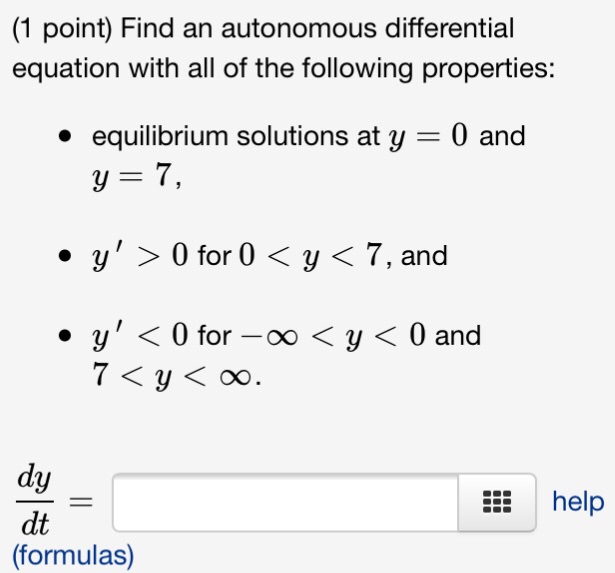
That is, if the right side does not depend on x, the equation is autonomous. A differential equation where the independent variable does not explicitly appear in its expression. Given a first order autonomous differential equation , an equilibrium point is a point such that.
It Is Called An Autonomous Differential Equation.
Notes on autonomous ordinary differential equations 3 lemma 2.2. For an autonomous ode, the solution is independent of the. We usually assume f is continuously differentiable.
An Autonomous Second Order Equation Can Be Converted Into A First Order Equation Relating V = Y ′ And Y.
Y ( 0) = y 0, y. As we have seen in many prior math courses, the solution is. The rule says that if the current value is y, then the rate of change is f ( y).
Which Of The Following Differential Equations Are Autonomous?
In this video, i will explain what an autonomous differential equation means, also i will show several examples. The differential equation we derived is given by. D y d t = f ( y).
Included Are Most Of The Standard Topics In 1St And 2Nd Order Differential Equations, Laplace Transforms, Systems Of Differential Eqauations, Series Solutions As Well As A Brief Introduction To Boundary Value Problems, Fourier Series And Partial Differntial.
V ′ = f(y, v). Where the derivative of solutions depends only on x (the dependent variable). It has the general form of y′ = f (y).
A Differential Equation Where The Independent Variable Does Not Explicitly Appear In Its Expression.
In this session we take a break from linear equations to study autonomous equations. Autonomous differential equation the first order differential equation (1) y0(x) = f(y(x)) has right side independent of x. Further, xis a stable equilibrium for (2.3) if and only if every solution y(t) of the di erential equation (2.4) dy dt (t) = ay(t) has the property that lim